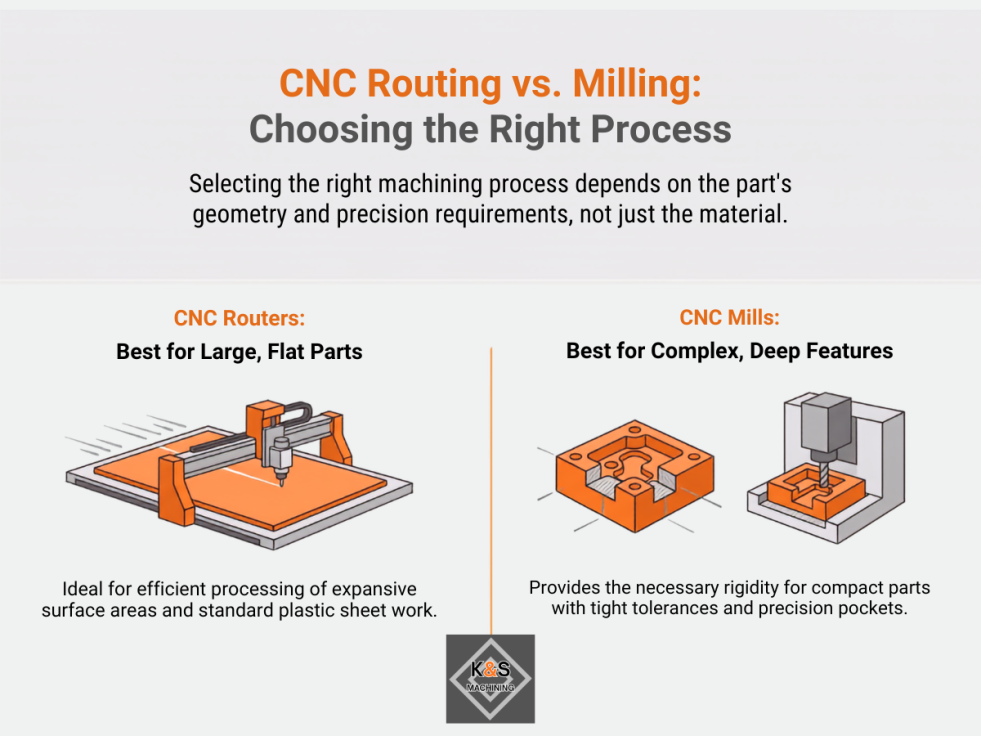
For large plastic sheets, flat profiles, panels, covers, and low to medium volume parts, CNC router machining is often the right choice over milling. We use routing to produce accurate plastic components efficiently, while the best process still depends on the material, part size, geometry, tooling, workholding, and inspection plan.
We’ll compare custom CNC routing for plastics with CNC milling, explain common plastic materials and realistic tolerances, and help engineers and buyers choose the right process and machining partner. First, we’ll look at how plastic materials and part requirements affect the decision between routing and milling.
What CNC Router Machining Does Best for Plastic Parts
CNC router machining is well suited for plastic sheets, panels, covers, gaskets, guards, and other parts with broad, relatively flat profiles. We can cut openings, pockets, mounting patterns, and complex outlines efficiently, while the right tooling and cutting conditions protect the material from melting, cracking, warping, and rough edges.
Which Plastics Can We Cut With a CNC Router?
Most common engineering plastics can be routed, but each material reacts differently under the cutter. Acrylic cuts cleanly and produces an attractive finished edge, although it can chip or crack if the tool is dull or the workpiece is poorly supported. ABS is impact-resistant and practical for housings, covers, and functional prototypes, but it can soften when heat builds up.
Acetal, commonly called Delrin, machines with good dimensional stability and produces clean chips when the cutter is sharp. HDPE and UHMW are softer and more flexible, so strong workholding and proper support are important. Without enough support, these materials can move during cutting or leave edges that are slightly out of position. Nylon is also workable, but its flexibility and tendency to absorb moisture can affect both cutting behavior and final dimensions.
Polycarbonate is tough and impact-resistant, though it can melt or develop a poor edge when the tool rubs instead of cutting. PVC can be routed with suitable tooling and chip evacuation, while PTFE is soft, slippery, and flexible enough to require careful support. PEEK and phenolic materials need more controlled conditions. PEEK can generate substantial heat, while phenolic is harder and more abrasive, which increases tool wear and the risk of edge damage.
Reinforced plastics, including glass-filled and carbon-filled grades, require additional care because the reinforcement can wear ordinary tools quickly and may leave a rough or fuzzy edge. We select cutters based on the material’s hardness, abrasiveness, flexibility, melting behavior, and chip formation. The material choice also affects whether we need extra hold-down, protective masking, air flow, or multiple lighter passes.
| Plastic type | Routing considerations |
|---|---|
| Acrylic and polycarbonate | Use sharp tools and controlled heat to limit chips, melting, and edge damage. |
| ABS, HDPE, and UHMW | Support the material well and evacuate chips before they recut. |
| Acetal and nylon | Generally machine cleanly, but feed, tool sharpness, and dimensional stability still matter. |
| PTFE and PEEK | Control flexibility and heat with suitable tooling and conservative cutting conditions. |
| Phenolic and reinforced plastics | Expect higher tool wear and use cutters designed for abrasive materials. |
Material selection should match the part’s load, temperature, chemical exposure, and tolerance requirements, not only its ease of cutting. Our team can also review whether a routed blank should move to a CNC mill for secondary holes, tighter features, or additional machining. In some projects, the router cuts the large profile first, then other equipment completes the precision work, as shown in our work with precision CNC router services for plastics.
How Tooling and Heat Control Affect the Finished Edge
Plastic does not conduct heat like metal, so heat can remain close to the cutting edge. A dull cutter, excessive spindle speed, or feed rate that is too slow can make the tool rub across the surface instead of producing a chip. That rubbing creates friction, softens the material, and may leave a melted edge, burr, or distorted profile.
We commonly use sharp single-flute or plastic-specific cutters because they provide more room for chip evacuation and reduce repeated contact with the workpiece. The correct chip load is just as important as the cutter itself. If the feed is too low, the tool polishes the plastic. If it is too high, the edge can chip, the part can shift, or the cutter can overload.
Air blast is often useful for removing chips and carrying heat away, while coolant depends on the plastic and the application. Workholding must keep the sheet flat without crushing or deforming it, especially with HDPE, UHMW, PTFE, and other flexible materials. Heat control during plastic routing is a key part of protecting dimensional accuracy.
After routing, we can deburr edges, lightly polish clear acrylic, countersink holes, or apply protective masking when appearance and fit matter. These finishing steps remove sharp remnants and help the part install correctly without changing the designed geometry. When the material, tooling, and workholding are matched to the job, CNC routing delivers clean plastic parts with dependable repeatability. For a practical next step, send your drawings through Request A Quote and our team can review the material, geometry, tolerances, and production requirements.
Plastic CNC Routing Tolerances: What Engineers Should Expect
Plastic CNC routing tolerances depend on the material, part size, geometry, cutter, workholding, and inspection method. A broad plastic profile may hold a different tolerance than a small hole or press-fit feature, which is why we review critical dimensions before choosing the process plan.
Typical CNC-routed plastic parts may fall near ±0.005 to ±0.010 inch, although actual results vary with material and feature size, as described in these CNC routing tolerance guidelines. Engineers should treat that range as a starting point, not a blanket promise for every feature.
When Plastic Parts Need Tight Fits or Complex Features
Holes, slots, pockets, press fits, and mating surfaces deserve early attention because their function depends on more than the overall profile. A mounting hole may accept a fastener with a little clearance, while a bearing seat, dowel hole, or press fit needs closer control and a defined inspection method.
Thin walls and narrow ribs can flex during cutting, especially in HDPE, UHMW, nylon, PTFE, and other flexible plastics. The cutter applies side pressure, and the material can move away from the tool before returning toward its original position. If the drawing calls for a thin section, we may need additional support, lighter passes, modified toolpaths, or a different machining process.
Deep pockets and tall features also need review because tool deflection, chip evacuation, and limited access can affect the bottom and side walls. Large flat plastic parts create another concern. Temperature changes can alter the size of the sheet or finished part, and the effect becomes more noticeable across a wide span. Measuring a large part before it reaches a stable inspection temperature can produce confusing results.
Clear drawing notes help us make the right decisions before production begins. Include the following details when they apply:
- Functional tolerances for holes, slots, pockets, and mating surfaces.
- Surface finish or edge requirements for visible and sealing areas.
- Material grade, color, reinforcement, and certification requirements.
- Datums, inspection points, and the measurement method.
- Flatness, perpendicularity, or parallelism requirements for mating parts.
When material certification is required for aerospace, defense, oil and gas, or other controlled applications, include that requirement with the order documents. We can then plan material verification, routing, secondary machining, and inspection without creating delays later. Our precision CNC machining services in Alabama support prototype and low-volume work where critical details need direct review.
Design Tips That Make Routed Plastic Parts More Reliable
Plastic routing becomes more predictable when the drawing matches what the tool can physically cut. Sharp internal corners are a common example. A round cutter cannot produce a perfectly square inside corner, so adding a suitable corner radius can prevent extra tool passes, reduce stress concentration, and eliminate unnecessary secondary work.
We also recommend supporting thin walls wherever possible. A wider base, small reinforcing rib, or temporary bridge can keep a flexible section stable while the router removes material. Tool access matters as well, especially inside deep pockets or around tall features. If the cutter cannot reach the full wall height cleanly, the part may need a different setup or a secondary operation.
Tolerances should be assigned according to function, not applied tightly across every dimension. A general profile may not need the same control as a bearing bore or mating face. Applying tighter limits only where they provide value can reduce cycle time, rework, inspection cost, and material waste while improving repeatability. We review critical features early so we can select the proper cutter, workholding method, toolpath, and inspection plan before the first part is routed.
When a job involves complex features, strict tolerances, or a small production run, a specialized shop can provide more direct engineering communication than a high-volume production supplier. Large production shops may fit repeat orders with stable volumes, while our team is equipped to review demanding prototype and low-volume plastic parts with the attention those jobs require.
Request A Quote for Plastic CNC Routing
Send us your drawings, material requirements, tolerance callouts, and inspection needs. We machine your parts using a process plan matched to the geometry and application, then you deliver with confidence knowing the finished components were reviewed for fit, function, and repeatability. Request A Quote to start the review.
CNC Routing vs. Milling: Which Process Fits the Part?
The best process depends on the complete part, not simply the fact that the material is plastic. We compare the part size, thickness, profile, deep features, tolerance plan, production quantity, workholding requirements, and inspection needs before selecting CNC routing or milling.
A router is often the efficient choice for large, flat plastic work, while a CNC mill provides greater rigidity for compact parts with deep or precision features. In some cases, we use both processes, routing the main profile first and milling critical holes, pockets, or mating surfaces afterward.
Choose Routing When Size, Speed, and Sheet Efficiency Matter
CNC routing is usually the better fit when the part starts as a large plastic sheet and most features are two-dimensional or relatively shallow. Large panels, machine guards, covers, liners, gaskets, and flat mounting plates can often be cut efficiently on a router without the added setup required for a smaller milling machine.
Routing also works well when we can nest several parts on one sheet. Efficient nesting reduces scrap and limits the amount of material handling required between operations. Instead of securing each small blank separately, we can hold the sheet, machine repeated profiles, and separate the finished parts within the same program.
The process is especially practical for repeated outlines, cutouts, drilled patterns, shallow pockets, and profiles that need to be produced quickly. Low to medium production volumes are a common fit because routing can provide repeatable results without the tooling investment or setup burden associated with higher-volume production methods.
Consider routing when your part has these characteristics:
- A large length or width compared with its thickness.
- Multiple parts that can be nested from one sheet.
- Repeated outside profiles or internal openings.
- Short lead-time requirements.
- Low to medium production quantities.
- No need for deep pockets or complex 3D contours.
- General tolerances that match the material and router setup.
A routed sheet can also reduce setup time because the material arrives in a form that is ready for direct workholding. When the design matches the process, we spend less time cutting blanks, repositioning material, and creating separate fixtures. This helps control labor and material costs while keeping production moving.
Routing isn’t limited to simple rectangles. With the right cutter, toolpath, hold-down method, and chip evacuation plan, we can produce complex flat profiles in acrylic, polycarbonate, acetal, ABS, HDPE, UHMW, and other plastics. For a broader view of available equipment and support, review our full range of machining services.
Choose Milling When Rigidity, Depth, or Precision Comes First
CNC milling is the safer choice when the part’s geometry requires a more rigid setup or closer control of the cutting tool. Compact parts with deep pockets, close-tolerance bores, complex 3D contours, and several related datum surfaces can be difficult to hold accurately on a router.
A mill is also better suited for thick plastic stock when the cutter must remove substantial material or reach deep into the workpiece. Greater rigidity helps control tool deflection, vibration, and wall movement, which can affect pocket dimensions, bore location, surface finish, and perpendicularity.
Features that depend on multiple datum relationships deserve careful planning. A part may need a bore located from one face, a pocket aligned to that bore, and a second surface held parallel to the first. These relationships are easier to maintain when the part is secured in a rigid fixture and machined with controlled access to each feature.
Milling is generally the stronger option for:
- Deep pockets with controlled bottom and wall dimensions.
- Close-tolerance bores, reamed holes, and bearing seats.
- Complex 3D contours and angled surfaces.
- Thick stock that requires heavier material removal.
- Thin features that need firm support during cutting.
- Multiple datum relationships within one setup.
- Precision mating surfaces and functional fits.
Plastic does not automatically mean routing. The tolerance plan and feature geometry decide which process is appropriate.
We review the complete drawing before making that decision. A large plastic part may still need milling if it includes a precision bore or deep pocket, while a smaller part may route successfully when its features are shallow and its tolerances are moderate. The most reliable process is the one that supports the part’s critical dimensions, workholding needs, and inspection plan without adding unnecessary operations.
How We Match the Job to the Right CNC Machine Shop
The right CNC machine shop depends on more than the material, part size, or number of pieces. We also consider the drawing complexity, tolerance requirements, inspection plan, production volume, lead time, and level of engineering support your team needs.
A supplier that is well suited for a high-volume standardized part may not be the best choice for a complex plastic prototype. The same is true in reverse. We match the job to the shop environment that can produce it accurately, communicate clearly, and support the project through delivery.
When a Specialized Shop Is the Better Fit
A smaller specialized shop can be a strong choice for complex prototypes, low-volume production, unusual plastic materials, urgent work, and parts with tight-tolerance features. These jobs often need more review than a standard production order, especially when the drawing includes thin walls, deep pockets, close-fitting holes, or difficult datum relationships.
When you work directly with experienced machinists, questions can receive answers faster. We can review a challenging drawing, discuss the material behavior, identify possible workholding concerns, and recommend practical design-for-manufacturing changes before cutting begins. That feedback can prevent avoidable rework and help your team move from prototype to production with fewer delays.
Flexible scheduling is another advantage when the job doesn’t fit a standard production queue. A specialized shop may be able to prioritize an urgent prototype, adjust the machining plan after a drawing review, or manage a small batch without forcing it into a high-volume process built for different work.
That doesn’t mean smaller always means better. The shop still needs the equipment, quality controls, inspection tools, material knowledge, and production discipline required by your application. For prototype work, our precision prototype machining services give engineering teams a direct path to practical machining feedback and low-volume production support.
A specialized shop is often the better fit when you need:
- Direct communication with machinists and manufacturing personnel.
- Design feedback before production begins.
- Flexible scheduling for urgent or changing requirements.
- Experience with unusual plastics, composites, or difficult geometries.
- Tight-tolerance features on a small number of parts.
- Prototype and low-volume support without a large minimum order.
- A partner willing to review drawings that need additional discussion.
The goal is not to choose the smallest supplier. The goal is to choose a shop that will give your part the attention its tolerances and application require.
When a Large Production Shop Makes More Sense
A large production shop may be the better fit for very high volumes, highly standardized parts, dedicated automation, long blanket orders, or programs that require extensive capacity across multiple locations. If your part design is stable and demand is predictable, a production-focused supplier may provide efficient throughput, dedicated fixtures, automated inspection, and purchasing support for extended schedules.
Large suppliers can also make sense when your program requires global capacity, multiple production sites, or a substantial supply chain infrastructure. Those resources can help support long-term agreements and large releases, but they don’t remove the need for careful supplier evaluation.
Whether we work with a specialized shop or a large production supplier, we recommend comparing the same core requirements. A machine shop’s size is only one part of the decision. A basic machine shop services guide can help clarify the different capabilities suppliers may offer, but your drawing and inspection requirements should lead the conversation.
Ask each supplier about:
- Their quality system and inspection equipment.
- Available capacity for your required production volume.
- Material traceability and certification practices.
- Typical lead times for prototypes, releases, and repeat orders.
- Communication during design review and production.
- Experience holding your required plastic machining tolerances.
- How they manage nonconforming parts, changes, and rework.
A supplier may quote an attractive price but still create problems if its inspection process cannot verify your critical features or its capacity cannot support your release schedule. We review these factors before recommending CNC routing, milling, secondary operations, or a combination of processes.
Request A Quote
Send us your drawings, material specifications, tolerance callouts, quantities, and delivery requirements. We machine your parts using a process plan matched to the geometry, plastic material, workholding needs, and inspection requirements. You deliver with confidence knowing the job was reviewed by a team prepared to support complex prototypes and low-volume production.
Request A Quote and let us review whether our CNC router, CNC mill, or combined machining approach is the right fit for your plastic parts.
Request a Quote for Routed Plastic Parts
A reliable quote starts with complete project information. When we understand the material, geometry, tolerances, quantity, and inspection requirements, we can determine whether CNC routing, milling, or a combination of processes is the right fit for your plastic parts. That review helps us identify manufacturing risks early and provide pricing and lead-time information based on the actual job.
Send Us Your Drawings
Start by sending your 2D drawings, 3D CAD models, or both. A 3D model helps us understand the overall shape, pockets, openings, and feature relationships, while the drawing provides the dimensions, datums, tolerances, notes, and inspection requirements needed for production.
Please include the following information when requesting a quote:
- Plastic material, grade, color, thickness, and reinforcement.
- Part quantity, prototype quantity, and expected repeat orders.
- Critical dimensions, general tolerances, and fit requirements.
- Surface finish, edge condition, deburring, or masking requirements.
- Flatness, perpendicularity, parallelism, or other geometric controls.
- Material certifications, inspection records, or traceability requirements.
- Required delivery date and packaging instructions.
Material details are especially important for routed plastic parts because acrylic, polycarbonate, acetal, ABS, HDPE, UHMW, nylon, and reinforced plastics each respond differently to cutting heat, tool pressure, and workholding. If the material is flexible, abrasive, heat-sensitive, or moisture-sensitive, we need to know that before selecting the cutting approach.
The same applies to tolerances. A general profile may be suitable for routing, while a bearing seat, press fit, or closely located hole may require CNC milling after the main profile is cut. Complete information gives us a clear picture of the part instead of forcing us to make assumptions. You can submit your parts specifications for a quote along with the project files and production details.
We Machine Your Parts
After receiving the information, our team reviews the drawing and model for manufacturability. We look at part size, thickness, internal corners, wall stability, pocket depth, tool access, datum relationships, and the tolerances assigned to each functional feature.
Routing is often a practical choice for large sheets, flat profiles, panels, covers, and repeated cutouts. Milling may be more suitable for thick stock, deep pockets, close-tolerance holes, complex contours, or features that need a more rigid setup. Some parts use both processes, with the router producing the main outline and a CNC mill completing precision features.
We then plan the tooling, workholding, and cutting sequence around the plastic material and part geometry. Sharp tooling, proper chip evacuation, controlled cutting conditions, and stable support help limit melting, chipping, burrs, movement, and edge damage. For thin or flexible parts, the workholding plan is just as important as the toolpath because movement during machining can affect final dimensions.
During production, we machine the parts according to the approved requirements and monitor the features that affect fit and function. Critical holes, pockets, profiles, and mating surfaces can be checked using the inspection method defined for the project. If the order requires inspection records or specific documentation, we include those requirements in the production plan rather than treating them as an afterthought.
You Deliver With Confidence
Your finished parts need to arrive ready for the next operation, assembly, or production release. We support that outcome with clear communication during drawing review, practical process planning, and inspection focused on the features that matter to your application.
We discuss questions before machining begins, including material availability, tolerance concerns, secondary operations, packaging, and delivery timing. That communication gives your engineering and purchasing teams a clearer understanding of the job and reduces the risk of surprises after production starts. A detailed drawing package also makes it easier to compare quotes and confirm that suppliers are pricing the same requirements.
K&S Machining supports challenging plastic machining projects, functional prototypes, and low-volume production runs. If your parts include unusual materials, tight-tolerance features, large routed profiles, or a combination of routing and milling, send us the project details for review. Request A Quote and let our team help determine the right machining plan for your parts.
In Short
CNC routing is often the right choice for large, flat, sheet-based plastic parts, repeated profiles, and efficient cutouts. CNC milling is usually better when the part needs a rigid setup, deep features, complex 3D geometry, or tighter dimensional control. Material behavior, workholding, and functional tolerances should guide the process decision.
We review the complete part before recommending routing, milling, or a combination of both. If your project includes demanding plastic components, tight tolerance milling for plastics or large routed profiles, send us your drawings through Request A Quote so our team can review the requirements and provide a practical machining plan.
Need more Info? Click one of the links.